For eight years, many European treasurers paid for the privilege of holding cash. The ECB's deposit rate sat below zero from 2014 to 2022, and banks passed the cost through to corporate deposits. A generation of finance teams learned that there wasn't much benefit to moving funds from call accounts to a short-term notice account, and that chasing yield beyond that could be a dangerous pursuit. That instinct has outlived the world that created it. With the ECB deposit rate at 2.25% in mid-2026, every instrument on the menu pays something or should pay something, and the differences between them are worth real money.
The question that matters more than rate versus term
What is the higher rate compensating you for?
- Is it the shape of the interest rate curve? Generally, but not always upward sloping, naturally rewarding people for investing for longer.
- Is it liquidity premium, for locking up your funds for a longer term? And providing the bank with more stable funding?
- Is it available on small balances only? Helping banks diversify their funding and avoid concentration, but not much use for a large corporate.
- Is it credit premium for taking higher credit risk on a lower rated institution?
- Is it investment risk, compensation for the possibility of negative returns?
Or is there another risk you are taking that is less obvious?
The standard options
Bank deposits are the default: call accounts for instant access, notice accounts at 32 or 95 days for a little more, term deposits for a defined period at a defined rate for cash you know you don't need. Simple & familiar on the face of it, but each can carry different conditions in a stress. For example, instant access became a lot more instant in the age of neo-banking apps, but these apps now come with conditions about how much you can withdraw at once. The conditions are sufficient for most every-day banking requirements, depending on your plan, but they may not be sufficient to clear out your account should you need to take urgent action. How you access your funds beyond that hasn't been tested in a crisis. We cover deposits in more detail in the deposit deep-dive.
Money market funds pool hundreds of issuers into a single same-day-liquidity holding: diversification you couldn't build yourself. But a fund is not a deposit. The 2008 Reserve Primary episode proved the value can move, and the post-crisis reforms that created today's low volatility NAV (LVNAV) structures also formalised the gates and fees a fund can impose in stress. Read the terms in advance and ensure that risks and conditions are well understood. The MMF deep dive below covers how.
Direct purchases of bonds, T-bills, commercial paper, certificates of deposit and repo, cut out the intermediary entirely: you choose the issuer and the maturity. The price is operational: time, custody arrangements, dealing relationships and minimum sizes that only make sense once balances justify them.
Laddering: the unglamorous trick that works
Rather than one big deposit maturing on one date, split it into slices maturing monthly. A rolling ladder gives you regular liquidity without breaking anything, averages your reinvestment rate through the cycle, and removes the temptation to take a view on where rates go next.
The same job at three sizes
Start-up. Not a problem until you raise. … read more show less
A call deposit at a second bank plus one money market fund covers it. The goal is diversification and access, not yield engineering. Set it up in a week and go back to building the company.
Established mid-market. A notice-and-term deposit ladder across two or three banks, plus some Money Market Funds for the operating buffer. … read more show less
This is where an extra 30 or 40 basis points of organised behaviour, on €20m of average balances, quietly pays for a hire.
Large corporate. Direct portfolios of bills and paper, repo capacity, separately managed accounts with external managers. … read more show less
The instrument set expands; the questions that matter remain the same.
The menu at a glance
Five instruments, scored across the dimensions that actually decide between them.
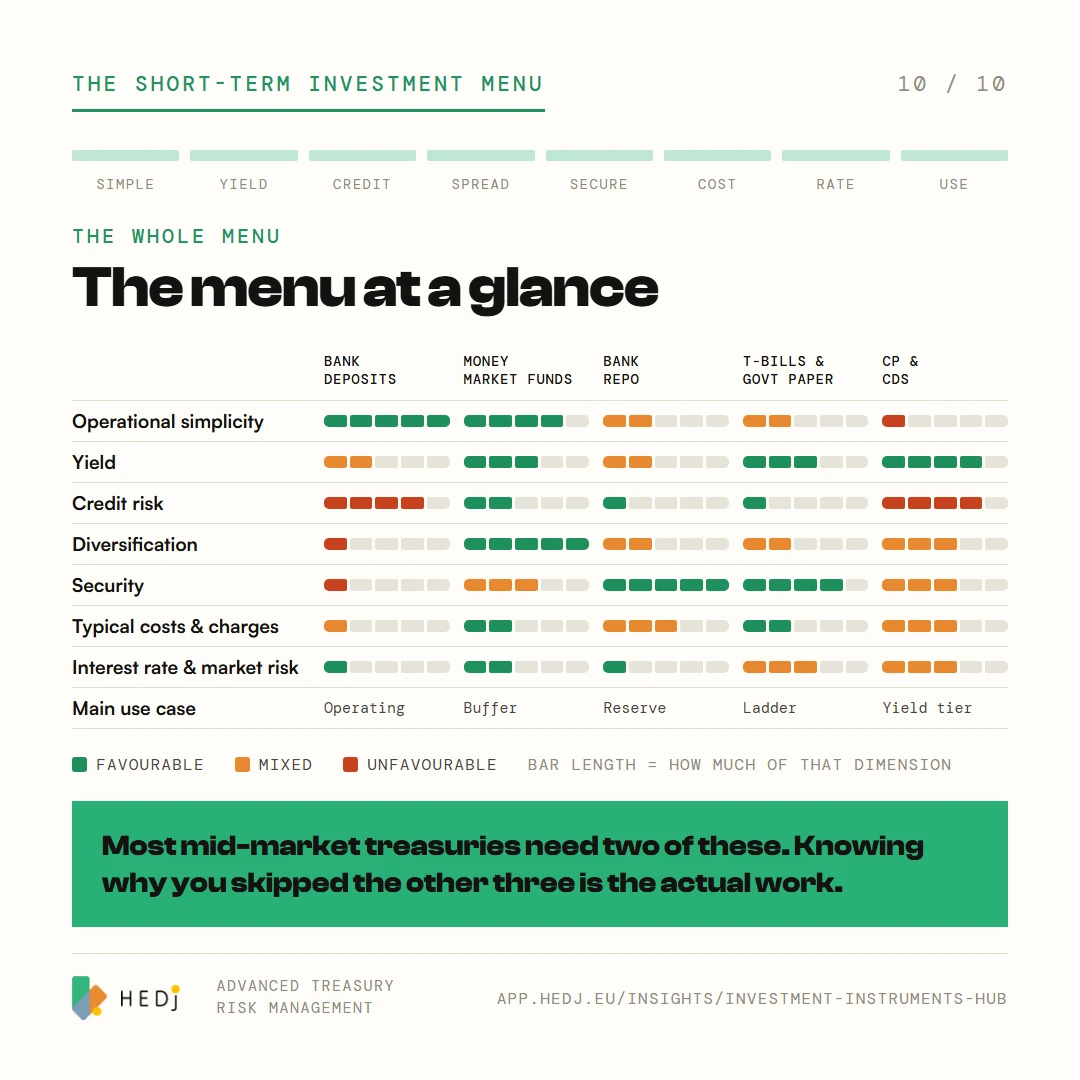
- Bank deposits Call, notice and term accounts at banks you already deal with. Nothing to set up, nothing to document, no new counterparty. What you give up is diversification and security, because a deposit is an unsecured loan to a single bank, and a competitive rate usually only arrives when you ask for one. Main use case: operating cash.
- Money market funds Hundreds of issuers in a single same-day-liquidity holding, with the credit work done by the manager. Diversification bought in one line item for 10-60bps. The trade is that a fund is not a deposit: the value can move, and the LVNAV rules allow gates and liquidity fees in a stress. Main use case: the buffer above operating cash.
- Bank repo Cash placed against a portfolio of government bonds, with a haircut in your favour. It takes the bank credit risk out without taking the money out of the bank relationship, and once the GMRA and the tri-party account exist the day-to-day feels close to a deposit. The legal work, the tri-party fees and ticket sizes in the tens of millions are the entry price. Main use case: the reserve tier.
- T-bills and government paper Sovereign, agency and supranational paper bought directly and usually held to maturity, in deep and liquid markets, as close to risk free as a currency gets. Security is high and running costs are low, but you need custody, dealing access and someone whose job it is to reinvest the maturities. Main use case: a rolling ladder.
- Commercial paper and CDs Bank and corporate short-term paper, the highest yielding tier on the menu and the only one where the credit decision is yours. That needs a genuine credit process and proper diversification, and it is the least operationally simple thing here. Main use case: the yield tier, once the rest of the structure is in place.
Most mid-market treasuries only need two of these, and the work is in knowing why you skipped the other three. We explore each of them in more detail in their own article: bank deposits, money market funds, bills, bonds, CP and CDs and bank repo.